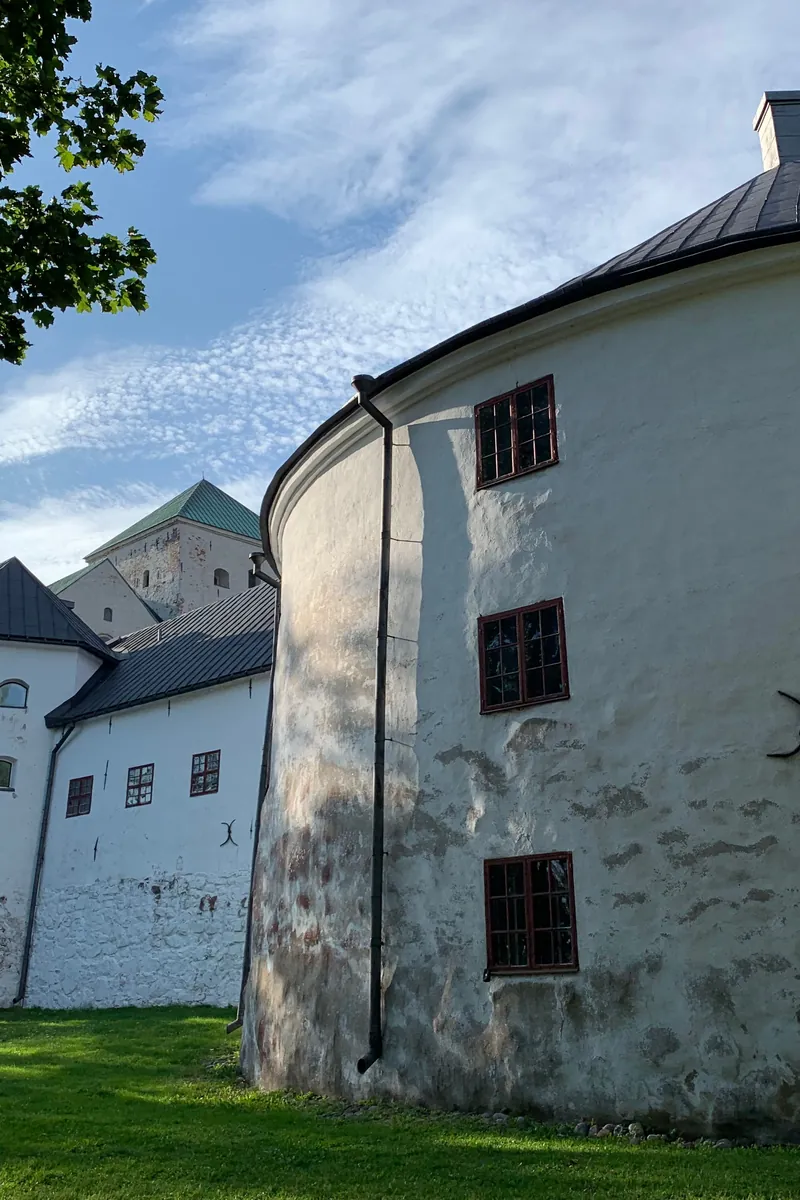
Turku Castle stands at the mouth of the Aura river in Turku, on Finland's south-west coast. Building work began in the 1280s, when Finland was part of the Kingdom of Sweden, making it the oldest of the castles the Swedish Crown built in Finland. The castle grew in stages over three centuries: a modest bailey fort became a formidable royal keep, then — under Gustav Vasa and his sons in the 16th century — was rebuilt again into a Renaissance residence with grand halls fit for a royal court.
The castle's two parts tell two different stories. The main castle (päälinna) holds the older, sterner architecture — stone walls around three metres thick, narrow stairways, and the vaulted rooms raised in the 1300s and 1400s: the King's Hall, the Nun's Chapel and the Gentlemen's Cellar, joined in the 1480s by the Sture Church built for governor Sten Sture the Elder. Once defence had moved outward to the bailey and the earthworks, the main castle itself was converted into a Renaissance palace in the renovation of 1556–1563, which added a new King's Hall to the north wing and completed the central staircase tower. The bailey (esilinna) took the round artillery tower of 1568–1574 and, centuries later, the prison.
A museum was established in the castle in 1885, and today Turku Castle runs as the Turku Castle Museum — Turku's most-visited museum in 2025, with over 123,000 visits. Two attic halls created in the postwar rebuilding hold the Northern Exhibition Hall's costume, jewellery and silver from the 17th to 19th centuries and the Southern Exhibition Hall's account of the restoration itself, while the bailey's History of Turku Castle exhibition traces the shift from defensive fortress to Renaissance palace and the later centuries as barracks, warehouse and prison. We handle the ticketing so your date-specific admission is confirmed before you arrive — one less thing to plan once you're in Turku.